Swarm Intelligence in Animal Groups: When Can a Collective Out-Perform an Expert? Robustness versus evolvability
Swarm Intelligence in Animal Groups
Saturday, December 4, 2010
Tuesday, November 30, 2010
Trinity Pavè,cartier
The following note is extracted part of the HFSP Journal article entitled "Robustness versus evolvability: A paradigm revisited," in Erich authors Bornberg-Bauer and Linus Kramer.
This article discusses the relationship between evolvability and robustness in biological systems. Evolvability is the property of many biological systems to adapt to new environmental viewing requirements. Robustness apparently corresponds to an opposite characteristic. However, many biological systems have two characteristics, which has been source of many debates in the past decades. A recently published model Draghi et al. [Nature 463, 353-355 (2010)], so elegantly avoids complications arising from laboratory observations of molecular systems by proposing an analytical solution, which surprisingly, is independent of the parameters chosen. Depending on the number of mutations, and the number of accessible phenotypes for any genotype, evolution and the Robuistez can be reconciled.
To go to the article (in English) press here.
The Following news item is taken in part from the June, 2010 issue of HFSP J titled “Robustness versus evolvability: A paradigm revisited,” by Erich Bornberg-Bauer and Linus Kramer.
Evolvability is the property of a biological system to quickly adapt to new requirements. Robustness seems to be the opposite. Nonetheless many biological systems display both properties–a puzzling observation, which has caused many debates over the last decades. A recently published model by Draghi et al. [Nature 463, 353–355 (2010)] elegantly circumvents complications of earlier in silico studies of molecular systems and provides an analytical solution, which is surprisingly independent from parameter choice. Depending on the mutation rate and the number of accessible phenotypes at any given genotype, evolvability and robustness Can Be Reconciled.
A link to this article Can Be found at http://dx.doi.org/10.2976/1.3404403.
Tuesday, September 21, 2010
Wording For Toy Story Invitations
PRIOR TO CONSTRUCTION
DUE TO TECHNICAL PROBLEMS THIS BLOG IS DISABLED AT THE MOMENT. SORRY
THANKS
DUE TO TECHNICAL PROBLEMS THIS BLOG IS DISABLED AT THE MOMENT. SORRY
THANKS
Wednesday, July 28, 2010
Ap Respiration Lab Crickets
Scrutiny
On Wed. 28/07 tutorial classes will be held prior to the test Integrator Introd. Scientific knowledge, in the Department of Anthropology at 18 hours. Cordially
The ICC Chair. NOTES
On Wed. 28/07 tutorial classes will be held prior to the test Integrator Introd. Scientific knowledge, in the Department of Anthropology at 18 hours. Cordially
The ICC Chair. NOTES
Sunday, May 30, 2010
Difference Between Beef Brisket And Shoulder Beef
Hidden Influence socialesHidden networks
TED Talk in Professor Nicholas A. Christakis, about how social networks influence the development of social phenomena. The importance of networks is not always obvious and this talk very well promote interest in identifying the importance and illustrate its effects, especially with the characterization of phenomenology as complex as obesity.
In English.
TED talk by Nicholas A. How social networks Christakis Influence on the Development of social phenomena. The Importance of networks is Not Always Obvious, and this talk does a very good job in highlighting andd Importance Identifying this STI effects, Specially with Regard to Such complex social phenomena as obesity.
Researcher Professor Christakis teaches at Harvard University and more about his work can be found at: Professor Teaches Christakis at Harvard University and more information on historical work dog Be found at:
1 .- Your page at Harvard / His harvard page
2 .- Page EDGE on his biography / EDGE article
3 .- Wikipedia
TED Talk in Professor Nicholas A. Christakis, about how social networks influence the development of social phenomena. The importance of networks is not always obvious and this talk very well promote interest in identifying the importance and illustrate its effects, especially with the characterization of phenomenology as complex as obesity.
In English.
TED talk by Nicholas A. How social networks Christakis Influence on the Development of social phenomena. The Importance of networks is Not Always Obvious, and this talk does a very good job in highlighting andd Importance Identifying this STI effects, Specially with Regard to Such complex social phenomena as obesity.
Researcher Professor Christakis teaches at Harvard University and more about his work can be found at: Professor Teaches Christakis at Harvard University and more information on historical work dog Be found at:
1 .- Your page at Harvard / His harvard page
2 .- Page EDGE on his biography / EDGE article
3 .- Wikipedia
Thursday, May 27, 2010
Japanese Teacher Kisses Student
Influence of Social Networks and the majority opinion of the Jury Theorem / Majority Opinion and the Jury Theorem
The great power of diversity is completely realized by using the opinion of the majority to make decisions. Michael Mauboussin
produces a very good demonstration of this with his students at Columbia Business School. Each year just before the Academy Awards are announced, a vote is made for those who believe they will be winners in each of the 12 categories in which prizes are awarded. Not only popular categories like "Best Actor" category, but more hidden as "Best Film Editing" or "best artistic direction."
In 2007, the average single correct answer was 5, 12. However, the average number of correct answers for the entire group was 11 December !
Why is the most accurate in their answers so frequently? One reason may be illustrated by the history of the development of U.S. Consititución, and two of his most famous craftsmen, Benjamin Franklin and Thomas Jefferson.
Franklin and Jefferson both spent time in Paris before participating in the creation of the constitution, which were experienced in 1787. Both were involved in doscusiones with French intellectuals pirmera primarily responsible for the French constitution, which was completed in 1789. One such intelectales was Marquis de Condorcet.
Condorecet had begun his career as a mathematician, and in that time worked as an inspector of coins at the Mint of Paris. He was fascinated by the idea that mathematics can be used to support arguments for human rights and moral principles.
Condercet Franklin met with many times after I arrived in Paris, and was very impressed by the progress that Condorcet had reached its "social mathematics," indicating that "should be discussed." There was nothing even Scytho about it, but that all changed after the publication of Condorcet's essay on the application of probability analysis to the decision of majorities, published in 1785.
Franklin was clearly influenced by the ideas of Condorcet, in particular mathematical proof by now known as the "Condorcet Jury Theorem," theorem that is now considered one of the foundations for our understanding of the democratic process.
Condorcet wanted to find a mathematical reason for a rational citizen accept the authority of the state as expressed through democratic election. He argued that the best reason would be if its individual probability of making the correct decision was less than the collective probability of choosing the correct alternative. His theorem appears to prove that this is almost always the case.
The theorem in its simplest form says that if each group member has a 50% chance correct answer to a problem with only 2 possible answers, then the possibility of a majority verdict is fast approaching 100% as the group size increases .
Even if the individual can get the correct answer is 60%, the possibility that get the most correct answer increases to 80% for a group of 17 people and 90% for a group of 45 people.The theorem Condorec jury appears as an impressive mathematical justification of the power that has the intelligence group in the democratic process. 5 however, depends on basic assumptions:
1 .- Individuals in the group must be independent, ie no deben influenciar las opiniones entre sí,
2.- No deben tener opinionbes tendenciadas (preconcevidas),
3.- Todos deben estar intentando responder la misma pregunta,
4.- Deben estar suficientemente bien informados: La probailidad de cad aindiviuo de obtener respuesta correcta debe ser mayor al 50%,
5.- Debe haber una respuesta correcta.
Estos cinco requerimientos implican que el teorema del jurado es util solo en muy restringido grupo de cisrcumstancias - aunque fue, y continua siendo, el punto de partida para discusiones sobre como se puede hacer funcionar a la democracia.
Caso práctico:
Si se analyze practical cases, when you apply this logic to the television show "Who Wants to be a millionaire", is that the answers to "consult the public" (90%) are consistently more accurate than those made by "ask the expert" (66 %)
also the assumption that each member of the audience needs to have a probability of more than 50% of obtaining a correct answer is also not necessary. A closer examination reveals that group intelligence works even if only a few know the answer and the rest of the individuals only chose to various probabilities of hitting .
To see how this works, try the following question with friends, a situation originally made by Scott Page: Of the following people, who was not a member of musical group the Monkees "in the 60's?: Peter Tork, Davy Jones, Roger Noll, and Michael Nesmith?
If this question is asked of 100 people, one possible scenario is that over two thirds (ie 68%) say they have no idea, 15 would know the miembos one of the group, 10 people could identify 2 members , and only 7 would know the correct answer. The correct answer is Roger Noll, an economist at Stanford. How many votes would it?
- 68 people with no idea, means that will randomly pick one of 4 options: 25% of them choose the correct answer:
17 - 15 identify only 1 member of the group, chosen at random from all 3 options remaining: 33% of correct answers: 5
- 10 people identify 2 members of the group: 50% chance of correct answer: 5
- 7 persons who have obtained 100% correct answer: 7
This makes a total of 34 correct answers, more than 22% of responses for each of the other options, a clear majority. Therefore
group intelligence works in these cases with only a few people are aware of the answers. In the above problem, the probability of choosing the correct answer would be greater even if 68 people had no idea of \u200b\u200bthe correct answer and 34 restrant only knew the name of 1 of the group. This would give 28 votes to the right answer and only 24 to each of the remaining possibilities.
The statistical distribution of knowledge may make this forecast a little less effective, but if the group size increases, the difference becomes more significant towards the correct answer.
Now, when the population reaches the millions, the majority vote can provide a very accurate guide, which is why search engines like Google, Yahoo or Digg.com, use it as an important guide in their ranking algorithms.
The Remarkable Power of diversity Reveals Itself When Fully it comes to using majority opinion to make decisions. Michael Mauboussin produces a neat demonstration in another experiment with his Columbia Business School students. Each year, just before the Academy Awards are announced, he gets the students to vote on who they think will win in each of twelve categories—not just popular categories like best actor but relatively obscure ones, like best film editing or best art direction.
In 2007, the average score for individuals within the group was 5 out of 12. The group as a whole, though, got 11 out of 12 right!
Why is the majority so often right? One reason can be illustrated by the story of the Constitution, and of two of its principle framers, Benjamin Franklin and Thomas Jefferson.
Franklin and Jefferson both spent time in Paris before working on framing the Constitution, which was adopted in 1787. Both of them became involved in discussions with French intellectuals who were primarily responsible for the first French constitution, which was completed in 1789. One of those intellectuals was the Marquis de Condorcet, a corresponding member of the American Philosophical Society, founded by Franklin in 1743 (and still going strong).
Condorcet had begun his career as a mathematician, but when Franklin met him he had been appointed as inspector-general of the Paris Mint at the instigation of the reforming economist Anne-Robert-Jacques Turgot. Turgot didn’t last long in the atmosphere of intrigue and double-dealing that characterized Louis XVI’s court, but Condorcet prospered. He also became fascinated by the idea that mathematics could be used to support arguments for human rights and moral principles.
Franklin met up with Condorcet many times after he arrived in Paris and was impressed by the progress that Condorcet had made with his “social mathematics,” saying at dinners he attended that it “had to be discussed.” Nothing was yet on paper, but that soon changed with the publication of Condorcet’s remarkable work Essay on the Application of Analysis to the Probability of Majority Decisions, published in 1785.
There is a copy of the book, signed by Condorcet himself, in Jefferson’s library.
Franklin was clearly influenced by Condorcet’s ideas, in particular by his mathematical proof of what is now known as “Condorcet’s jury theorem.” John Adams told Jefferson that Condorcet was a “mathematical charlatan,” but this was far from being the case, and Condorcet’s theorem is now regarded as a cornerstone for our understanding of democratic decision-making processes.
Condorcet wanted to find a mathematical reason for a rational citizen to accept the authority of the state as expressed through democratic choice. He argued that the best reason would be if his or her individual probability of making a correct choice was less than the collective probability of making a correct choice. His theorem appears to prove that this is nearly always the case.
The theorem in its simplest form says that if each member of a group has a better than 50:50 chance of getting the right answer to a question that has just two possible answers, then the chance of a majority verdict being correct rapidly becomes closer to 100 percent as the size of the group increases. Even if each individual has only a 60 percent chance of being right, the chance of the majority being right goes up to 80 percent for a group of seventeen and to 90 percent for a group of forty-five.
Condorcet’s jury theorem looks like a stunning mathematical justification of the power of group intelligence in the democratic process, but it relies on five crucial assumptions, some of which are similar, though not identical, to the elements of cognitive diversity:
1.- the individuals in the group must be independent, which means that that they mustn’t influence each other’s opinions
2.- they must be unbiased
3.- they must all be trying to answer the same question
4.- they must be well-informed enough to have a better than 50:50 chance of getting the right answer to the question
5.- there must be a right answer
These requirements mean that the jury theorem is useful only in a very restricted range of circumstances—although it was (and continues to be) a concrete starting point for discussions on how democracy can best be made to work, and on the way that consensus decisions are arrived at in nature. Condorcet even used it after the French Revolution to suggest the best method of jury trial for the king, but his ideas were not taken up in an atmosphere that was more concerned with retribution than with fairness.
Condorcet also invoked the jury theorem in a discussion about the structure of government under the new U.S. Constitution. A point on which all the Framers were firm was that the new government should consist of two houses—a House of Representatives, representing the people, and a Senate, representing the states. When copies of the U.S. Constitution arrived in Paris in November 1787, Condorcet wrote to Franklin, complaining that such a bicameral legislature was a waste of time and money because, according to his mathematical approach to decision making, “increasing the number of legislative bodies could never increase the probability of obtaining true decisions.”
The point that Condorcet missed was that the two houses were put in place to answer slightly different questions. The U.S. Supreme Court made this clear in a 1983 judgment about the functions of the two houses when it said, “the Great Compromise [of Article I], under which one House was viewed as representing the people and the other the states, allayed the fears of both the large and the small states.” In other words, the House of Representatives is there to ask, “Is X good for the people?” while the Senate’s job is to ask, “Is X best implemented by the federal government or by the states?” The fact that the two houses are answering slightly different questions negates Condorcet’s argument that one of the houses is redundant.
It might appear that the jury theorem is more relevant to the functioning of juries themselves, but here again it is a matter of how juries are set up. To take maximum advantage of group intelligence, jurors need to be truly independent, which means that each would need to listen to the arguments of both sides and then make a decision without discussing it with the other jurors. The decisions would then be pooled, and the majority decision accepted.
Condorcet suggested that Louis XVI’s jury be set up in this way, but his ideas were rejected, and as far as I can find there have been no tests of his proposal since, in France or elsewhere. It does seem a pity, because discussions between jury members before coming to a decision mean that one of the main foundations of group intelligence (that of independence) is lost. Discussions certainly have their value—allowing people to change their minds under the influence of reasoned argument—but other forces can also be at work. One of these is the social pressure to conform with other members of the group that goes under the name of “groupthink,” and which I discuss in the next chapter. So long as members of juries continue to thrash out the merits of a case between themselves before coming to a conclusion in the manner depicted in the film Twelve Angry Men, the jury theorem will largely be irrelevant to their deliberations.
It comes into its own, however, when applied to the game show Who Wants to Be a Millionaire? although it turns out that our collective judgment is even more reliable than the theorem suggests. James Surowiecki points out that the “Ask the Audience” option consistently outperforms the “Call an Expert” option. This group of “folks with nothing better to do on a weekday afternoon” produces the correct answer 90 percent of the time, while preselected experts can only manage 66 percent.
It seems like an ideal case for the jury theorem. The selections are independent. The audience is presumably unbiased. Its members are all trying to answer the same question, and the question has a definite right answer.
The assumption that all members of the audience need to have a better than 50 percent chance of getting the answer right, however, is not necessary. Close examination reveals that their group intelligence still works even if only a few people know the answer and the rest are guessing to various degrees.
To see how this works, try the following question, originated by Scott Page, on your friends. Out of Peter Tork, Davy Jones, Roger Noll, and Michael Nesmith, which one was not a member of the Monkees in the 1960s?
If you ask this question of 100 people, one possible scenario is that more than two-thirds (68, say) of them will have no clue, 15 will know the name of one of the Monkees, 10 will be able to pick two of them, and only 7 know all three. The non-Monkee is Roger Noll, a Stanford economist. How many votes will he get?
Seventeen of the 68 will choose Noll as a random choice. Five of the 15 will select him as one choice out of three. Five of the 10 will select him as one choice out of two. And all of the 7 will choose him. This gives a total of 34 votes for Noll, compared to 22 for each of the others—a very clear majority.
So group intelligence can work in this case with only a few moderately knowledgeable people in the group. It would even have a fair chance of working if 68 people had no clue and the remaining 32 only knew the name of one Monkee. One-third of these (11 to the nearest whole figure) would choose Noll as the exception, giving an average total of 28 votes for Noll and 24 for each of the others.
Statistical scatter makes this prognostication less sure, but with increasing group size the difference becomes more meaningful.
When it reaches the millions, the majority vote can provide a very sure guide, which is why search engines such as Google, Yahoo, and Digg.com use it as an important guide in their ranking algorithms.
The great power of diversity is completely realized by using the opinion of the majority to make decisions. Michael Mauboussin
produces a very good demonstration of this with his students at Columbia Business School. Each year just before the Academy Awards are announced, a vote is made for those who believe they will be winners in each of the 12 categories in which prizes are awarded. Not only popular categories like "Best Actor" category, but more hidden as "Best Film Editing" or "best artistic direction."
In 2007, the average single correct answer was 5, 12. However, the average number of correct answers for the entire group was 11 December !
Why is the most accurate in their answers so frequently? One reason may be illustrated by the history of the development of U.S. Consititución, and two of his most famous craftsmen, Benjamin Franklin and Thomas Jefferson.
Franklin and Jefferson both spent time in Paris before participating in the creation of the constitution, which were experienced in 1787. Both were involved in doscusiones with French intellectuals pirmera primarily responsible for the French constitution, which was completed in 1789. One such intelectales was Marquis de Condorcet.
Condorecet had begun his career as a mathematician, and in that time worked as an inspector of coins at the Mint of Paris. He was fascinated by the idea that mathematics can be used to support arguments for human rights and moral principles.
Condercet Franklin met with many times after I arrived in Paris, and was very impressed by the progress that Condorcet had reached its "social mathematics," indicating that "should be discussed." There was nothing even Scytho about it, but that all changed after the publication of Condorcet's essay on the application of probability analysis to the decision of majorities, published in 1785.
Franklin was clearly influenced by the ideas of Condorcet, in particular mathematical proof by now known as the "Condorcet Jury Theorem," theorem that is now considered one of the foundations for our understanding of the democratic process.
Condorcet wanted to find a mathematical reason for a rational citizen accept the authority of the state as expressed through democratic election. He argued that the best reason would be if its individual probability of making the correct decision was less than the collective probability of choosing the correct alternative. His theorem appears to prove that this is almost always the case.
The theorem in its simplest form says that if each group member has a 50% chance correct answer to a problem with only 2 possible answers, then the possibility of a majority verdict is fast approaching 100% as the group size increases .
Even if the individual can get the correct answer is 60%, the possibility that get the most correct answer increases to 80% for a group of 17 people and 90% for a group of 45 people.The theorem Condorec jury appears as an impressive mathematical justification of the power that has the intelligence group in the democratic process. 5 however, depends on basic assumptions:
1 .- Individuals in the group must be independent, ie no deben influenciar las opiniones entre sí,
2.- No deben tener opinionbes tendenciadas (preconcevidas),
3.- Todos deben estar intentando responder la misma pregunta,
4.- Deben estar suficientemente bien informados: La probailidad de cad aindiviuo de obtener respuesta correcta debe ser mayor al 50%,
5.- Debe haber una respuesta correcta.
Estos cinco requerimientos implican que el teorema del jurado es util solo en muy restringido grupo de cisrcumstancias - aunque fue, y continua siendo, el punto de partida para discusiones sobre como se puede hacer funcionar a la democracia.
Caso práctico:
Si se analyze practical cases, when you apply this logic to the television show "Who Wants to be a millionaire", is that the answers to "consult the public" (90%) are consistently more accurate than those made by "ask the expert" (66 %)
also the assumption that each member of the audience needs to have a probability of more than 50% of obtaining a correct answer is also not necessary. A closer examination reveals that group intelligence works even if only a few know the answer and the rest of the individuals only chose to various probabilities of hitting .
To see how this works, try the following question with friends, a situation originally made by Scott Page: Of the following people, who was not a member of musical group the Monkees "in the 60's?: Peter Tork, Davy Jones, Roger Noll, and Michael Nesmith?
If this question is asked of 100 people, one possible scenario is that over two thirds (ie 68%) say they have no idea, 15 would know the miembos one of the group, 10 people could identify 2 members , and only 7 would know the correct answer. The correct answer is Roger Noll, an economist at Stanford. How many votes would it?
- 68 people with no idea, means that will randomly pick one of 4 options: 25% of them choose the correct answer:
17 - 15 identify only 1 member of the group, chosen at random from all 3 options remaining: 33% of correct answers: 5
- 10 people identify 2 members of the group: 50% chance of correct answer: 5
- 7 persons who have obtained 100% correct answer: 7
This makes a total of 34 correct answers, more than 22% of responses for each of the other options, a clear majority. Therefore
group intelligence works in these cases with only a few people are aware of the answers. In the above problem, the probability of choosing the correct answer would be greater even if 68 people had no idea of \u200b\u200bthe correct answer and 34 restrant only knew the name of 1 of the group. This would give 28 votes to the right answer and only 24 to each of the remaining possibilities.
The statistical distribution of knowledge may make this forecast a little less effective, but if the group size increases, the difference becomes more significant towards the correct answer.
Now, when the population reaches the millions, the majority vote can provide a very accurate guide, which is why search engines like Google, Yahoo or Digg.com, use it as an important guide in their ranking algorithms.
The Remarkable Power of diversity Reveals Itself When Fully it comes to using majority opinion to make decisions. Michael Mauboussin produces a neat demonstration in another experiment with his Columbia Business School students. Each year, just before the Academy Awards are announced, he gets the students to vote on who they think will win in each of twelve categories—not just popular categories like best actor but relatively obscure ones, like best film editing or best art direction.
In 2007, the average score for individuals within the group was 5 out of 12. The group as a whole, though, got 11 out of 12 right!
Why is the majority so often right? One reason can be illustrated by the story of the Constitution, and of two of its principle framers, Benjamin Franklin and Thomas Jefferson.
Franklin and Jefferson both spent time in Paris before working on framing the Constitution, which was adopted in 1787. Both of them became involved in discussions with French intellectuals who were primarily responsible for the first French constitution, which was completed in 1789. One of those intellectuals was the Marquis de Condorcet, a corresponding member of the American Philosophical Society, founded by Franklin in 1743 (and still going strong).
Condorcet had begun his career as a mathematician, but when Franklin met him he had been appointed as inspector-general of the Paris Mint at the instigation of the reforming economist Anne-Robert-Jacques Turgot. Turgot didn’t last long in the atmosphere of intrigue and double-dealing that characterized Louis XVI’s court, but Condorcet prospered. He also became fascinated by the idea that mathematics could be used to support arguments for human rights and moral principles.
Franklin met up with Condorcet many times after he arrived in Paris and was impressed by the progress that Condorcet had made with his “social mathematics,” saying at dinners he attended that it “had to be discussed.” Nothing was yet on paper, but that soon changed with the publication of Condorcet’s remarkable work Essay on the Application of Analysis to the Probability of Majority Decisions, published in 1785.
There is a copy of the book, signed by Condorcet himself, in Jefferson’s library.
Franklin was clearly influenced by Condorcet’s ideas, in particular by his mathematical proof of what is now known as “Condorcet’s jury theorem.” John Adams told Jefferson that Condorcet was a “mathematical charlatan,” but this was far from being the case, and Condorcet’s theorem is now regarded as a cornerstone for our understanding of democratic decision-making processes.
Condorcet wanted to find a mathematical reason for a rational citizen to accept the authority of the state as expressed through democratic choice. He argued that the best reason would be if his or her individual probability of making a correct choice was less than the collective probability of making a correct choice. His theorem appears to prove that this is nearly always the case.
The theorem in its simplest form says that if each member of a group has a better than 50:50 chance of getting the right answer to a question that has just two possible answers, then the chance of a majority verdict being correct rapidly becomes closer to 100 percent as the size of the group increases. Even if each individual has only a 60 percent chance of being right, the chance of the majority being right goes up to 80 percent for a group of seventeen and to 90 percent for a group of forty-five.
Condorcet’s jury theorem looks like a stunning mathematical justification of the power of group intelligence in the democratic process, but it relies on five crucial assumptions, some of which are similar, though not identical, to the elements of cognitive diversity:
1.- the individuals in the group must be independent, which means that that they mustn’t influence each other’s opinions
2.- they must be unbiased
3.- they must all be trying to answer the same question
4.- they must be well-informed enough to have a better than 50:50 chance of getting the right answer to the question
5.- there must be a right answer
These requirements mean that the jury theorem is useful only in a very restricted range of circumstances—although it was (and continues to be) a concrete starting point for discussions on how democracy can best be made to work, and on the way that consensus decisions are arrived at in nature. Condorcet even used it after the French Revolution to suggest the best method of jury trial for the king, but his ideas were not taken up in an atmosphere that was more concerned with retribution than with fairness.
Condorcet also invoked the jury theorem in a discussion about the structure of government under the new U.S. Constitution. A point on which all the Framers were firm was that the new government should consist of two houses—a House of Representatives, representing the people, and a Senate, representing the states. When copies of the U.S. Constitution arrived in Paris in November 1787, Condorcet wrote to Franklin, complaining that such a bicameral legislature was a waste of time and money because, according to his mathematical approach to decision making, “increasing the number of legislative bodies could never increase the probability of obtaining true decisions.”
The point that Condorcet missed was that the two houses were put in place to answer slightly different questions. The U.S. Supreme Court made this clear in a 1983 judgment about the functions of the two houses when it said, “the Great Compromise [of Article I], under which one House was viewed as representing the people and the other the states, allayed the fears of both the large and the small states.” In other words, the House of Representatives is there to ask, “Is X good for the people?” while the Senate’s job is to ask, “Is X best implemented by the federal government or by the states?” The fact that the two houses are answering slightly different questions negates Condorcet’s argument that one of the houses is redundant.
It might appear that the jury theorem is more relevant to the functioning of juries themselves, but here again it is a matter of how juries are set up. To take maximum advantage of group intelligence, jurors need to be truly independent, which means that each would need to listen to the arguments of both sides and then make a decision without discussing it with the other jurors. The decisions would then be pooled, and the majority decision accepted.
Condorcet suggested that Louis XVI’s jury be set up in this way, but his ideas were rejected, and as far as I can find there have been no tests of his proposal since, in France or elsewhere. It does seem a pity, because discussions between jury members before coming to a decision mean that one of the main foundations of group intelligence (that of independence) is lost. Discussions certainly have their value—allowing people to change their minds under the influence of reasoned argument—but other forces can also be at work. One of these is the social pressure to conform with other members of the group that goes under the name of “groupthink,” and which I discuss in the next chapter. So long as members of juries continue to thrash out the merits of a case between themselves before coming to a conclusion in the manner depicted in the film Twelve Angry Men, the jury theorem will largely be irrelevant to their deliberations.
It comes into its own, however, when applied to the game show Who Wants to Be a Millionaire? although it turns out that our collective judgment is even more reliable than the theorem suggests. James Surowiecki points out that the “Ask the Audience” option consistently outperforms the “Call an Expert” option. This group of “folks with nothing better to do on a weekday afternoon” produces the correct answer 90 percent of the time, while preselected experts can only manage 66 percent.
It seems like an ideal case for the jury theorem. The selections are independent. The audience is presumably unbiased. Its members are all trying to answer the same question, and the question has a definite right answer.
The assumption that all members of the audience need to have a better than 50 percent chance of getting the answer right, however, is not necessary. Close examination reveals that their group intelligence still works even if only a few people know the answer and the rest are guessing to various degrees.
To see how this works, try the following question, originated by Scott Page, on your friends. Out of Peter Tork, Davy Jones, Roger Noll, and Michael Nesmith, which one was not a member of the Monkees in the 1960s?
If you ask this question of 100 people, one possible scenario is that more than two-thirds (68, say) of them will have no clue, 15 will know the name of one of the Monkees, 10 will be able to pick two of them, and only 7 know all three. The non-Monkee is Roger Noll, a Stanford economist. How many votes will he get?
Seventeen of the 68 will choose Noll as a random choice. Five of the 15 will select him as one choice out of three. Five of the 10 will select him as one choice out of two. And all of the 7 will choose him. This gives a total of 34 votes for Noll, compared to 22 for each of the others—a very clear majority.
So group intelligence can work in this case with only a few moderately knowledgeable people in the group. It would even have a fair chance of working if 68 people had no clue and the remaining 32 only knew the name of one Monkee. One-third of these (11 to the nearest whole figure) would choose Noll as the exception, giving an average total of 28 votes for Noll and 24 for each of the others.
Statistical scatter makes this prognostication less sure, but with increasing group size the difference becomes more meaningful.
When it reaches the millions, the majority vote can provide a very sure guide, which is why search engines such as Google, Yahoo, and Digg.com use it as an important guide in their ranking algorithms.
Sunday, May 23, 2010
Put Your Head Hairstyle
crowd dynamics and design proposals / Crowd Dynamics and Design Proposals
Un interesante paper de investigacion donde se analizan una serie de situación de flujo de multitudes, y donde se proponen alternativas de diseño para evitar los efectos no deseados more common in these situations.
An interesting research paper WHERE crowd flow dynamics in Situations Are analyze, and Design Considerations Are Proposed to Avoid Unwanted Their usual MOST results.
Self-Organized pedestrian crowd dynamics, simulations and experiments design solutions
Un interesante paper de investigacion donde se analizan una serie de situación de flujo de multitudes, y donde se proponen alternativas de diseño para evitar los efectos no deseados more common in these situations.
An interesting research paper WHERE crowd flow dynamics in Situations Are analyze, and Design Considerations Are Proposed to Avoid Unwanted Their usual MOST results.
Self-Organized pedestrian crowd dynamics, simulations and experiments design solutions
Saturday, May 22, 2010
Piano Type Burtonsnowboard
Alert: first cell Synthetic / Alert: Synthetic cell first
esperdo In an announcement but concerned by the May 21, 2010, Craig Venter announced the creation of first synthetic cell, whose DNA was designed by a computer.
But Anyway Expected In an unsettling announcement on 21 May 2010, Craig Venter on the INFORMS Successful creation of an synthetic Cell, Whose DNA Has Been Completely designed by a computer.
esperdo In an announcement but concerned by the May 21, 2010, Craig Venter announced the creation of first synthetic cell, whose DNA was designed by a computer.
But Anyway Expected In an unsettling announcement on 21 May 2010, Craig Venter on the INFORMS Successful creation of an synthetic Cell, Whose DNA Has Been Completely designed by a computer.
Thursday, May 20, 2010
Lots Of Phlegm With A Little Blood
Swarm intelligence for optimal path solution / swarm intelligence solutions for optimal route networks
The process of ant colony optimization is a process of very simple rules but very powerful effect in conditions of limited information (as in the case of most of our real problems), and through use of agents that are leaving "traces" of its passage through a specific route.
Can we use this method for the solution of practical problems in everyday life? Indeed, it can be. This approach to a practical problem arises for many years in 1856, and when the designers of Central Park in New York were to define the routes that have crosswalks.
response Robert J. Dillon, one of the designers was that the definition of these roads was postponed until the pedestrians themselves had established the best routes for its use. That is, apovechar proposed swarm intelligence of the people of New York that made use of the park, to determine more efficient routes. Those most used roads would leave alone as marking the pedestrian crossing impedes the growth of vegetation. The
pedestrian crossing and the subsequent delay in the growth of vegetation by this step, equivalent to the pheromone trail left by ants. Furthermore, the subsequent growth of vegetation should not be much pedestrian traffic, equivalent to the evaporation of pheromones, resulting in a nonlinear decrease of trails, paths and deleting non-privileged.
This phenomenon is widely visible in a variety of situations and a variety of sources: 1 .-
busiest roads in the hills for hikers,
2 .- Sites of recommendation from other Internet sites (such as Digg.com , or Stumbleupon, in which case let surfers recommendations of favorite sites, equivalent to "traces" of pheromone viewable by other surfers),
3 .- trail blazed by the Bushmen in the Kalahari Desert,
4 .- Andean Trails used for cattle grazing or migrating, paths in forests used by small mammals,
5 .- etc.
Unfortunately the idea was rejected, but this example of positive feedback has been proven to be a method of obtaining efficient solutions.
"Ant Colony Optimization is a process of very simple rules, But Powerful effect of very limited information in Conditions of (most of Our real problems), and Through the use of agents That leave trails of Their path through to specific route. Could we use
a similar procedure to resolve traveling and networking problems in our own lives? Robert J. Dillon, one of the original Central Park commissioners, had one idea when he suggested in 1856 that the planning of pathways in the park should be postponed until New York City pedestrians had established them by habit, with the more deeply marked paths corresponding to those that were most used and therefore most efficient.
In other words, he proposed making use of the Swarm Intelligence of the population that used Central Park to determine those routes . Those routes used most frequently would become clear as each transit delayed vegetation growth (equivalent to the pheromone trail in the case of an ant colony). On the other hand, if a route was less travelled, vegetation would slowly start to grow again, process that would be equivalent to feromone evaporation, leading to a non-linear elimination of less-privileged routes.
This phenomenon is evident in a series of situations:
1.- Walking trains in mountains, situation similar to the central park example,
2.- Recommendation sites such as Digg.com or StumbleUpon (user recommendation would amount to "pheromone" creation as the recomendation is seen by other users),
3.- Bushmen trails through the kalahari desert,
4.- Trails through forests as used by small animals, etc.
Dillon did not get his way, but recent research by German traffic engineer Dirk Helbing and his colleagues has shown that Dillon’s solution, a neat example of ant colony optimization as Practiced in Humane Society Would Have Been a good one.
The process of ant colony optimization is a process of very simple rules but very powerful effect in conditions of limited information (as in the case of most of our real problems), and through use of agents that are leaving "traces" of its passage through a specific route.
Can we use this method for the solution of practical problems in everyday life? Indeed, it can be. This approach to a practical problem arises for many years in 1856, and when the designers of Central Park in New York were to define the routes that have crosswalks.
response Robert J. Dillon, one of the designers was that the definition of these roads was postponed until the pedestrians themselves had established the best routes for its use. That is, apovechar proposed swarm intelligence of the people of New York that made use of the park, to determine more efficient routes. Those most used roads would leave alone as marking the pedestrian crossing impedes the growth of vegetation. The
pedestrian crossing and the subsequent delay in the growth of vegetation by this step, equivalent to the pheromone trail left by ants. Furthermore, the subsequent growth of vegetation should not be much pedestrian traffic, equivalent to the evaporation of pheromones, resulting in a nonlinear decrease of trails, paths and deleting non-privileged.
This phenomenon is widely visible in a variety of situations and a variety of sources: 1 .-
busiest roads in the hills for hikers,
2 .- Sites of recommendation from other Internet sites (such as Digg.com , or Stumbleupon, in which case let surfers recommendations of favorite sites, equivalent to "traces" of pheromone viewable by other surfers),
3 .- trail blazed by the Bushmen in the Kalahari Desert,
4 .- Andean Trails used for cattle grazing or migrating, paths in forests used by small mammals,
5 .- etc.
Unfortunately the idea was rejected, but this example of positive feedback has been proven to be a method of obtaining efficient solutions.
"Ant Colony Optimization is a process of very simple rules, But Powerful effect of very limited information in Conditions of (most of Our real problems), and Through the use of agents That leave trails of Their path through to specific route. Could we use
a similar procedure to resolve traveling and networking problems in our own lives? Robert J. Dillon, one of the original Central Park commissioners, had one idea when he suggested in 1856 that the planning of pathways in the park should be postponed until New York City pedestrians had established them by habit, with the more deeply marked paths corresponding to those that were most used and therefore most efficient.
In other words, he proposed making use of the Swarm Intelligence of the population that used Central Park to determine those routes . Those routes used most frequently would become clear as each transit delayed vegetation growth (equivalent to the pheromone trail in the case of an ant colony). On the other hand, if a route was less travelled, vegetation would slowly start to grow again, process that would be equivalent to feromone evaporation, leading to a non-linear elimination of less-privileged routes.
This phenomenon is evident in a series of situations:
1.- Walking trains in mountains, situation similar to the central park example,
2.- Recommendation sites such as Digg.com or StumbleUpon (user recommendation would amount to "pheromone" creation as the recomendation is seen by other users),
3.- Bushmen trails through the kalahari desert,
4.- Trails through forests as used by small animals, etc.
Dillon did not get his way, but recent research by German traffic engineer Dirk Helbing and his colleagues has shown that Dillon’s solution, a neat example of ant colony optimization as Practiced in Humane Society Would Have Been a good one.
Tuesday, May 18, 2010
How To Soften Cotton Hankies
Dynamics study of samples / Sample
The study of networks using graph theory, for example, can lead us to better understand the distribution of information through the network. A very special case is the dynamics of disease transmission. Depending on the contact that each node has with other nodes in the network, this will directly influence the spread of infection.
However, setting graph social networking is not a simple issue, because these networks tend to spread very quickly and in a social context is rarely the case where all contacts between agents are restricted to a few hundred individuals. Any study of the distribution of contacts should include several thousands of agents to contain some valuable information.
Within this context, studies attempting to explain dynamics of infection by taking only a few samples of the study population and class relations. View
study (in English) here
Networks Through The study of graph theory, for instance, can lead us to Better Understand the distribution of information Within a network. A very particular case is the instance of contageous Outbreaks. Depending on the node you connect with Each Other nodes, this will directly influence the contagious outbreak development.
However, making the graph distribution even of a very simple group is no easy task., since contacts tend to radiate very quickly, and it is a very rare instance where all possible contacts can be reduced to a few hhundred individuals. Any study on the distribution of contacts will include at least a few thousand individuals to deliver any meaningful information.
Within this context, there has been the development of studies to substantiate the possibility of making approximations to the dynamics of contageous outbreaks through the use of sample individuales and the study of only these individual's first tier contacts.
Access this study here
The study of networks using graph theory, for example, can lead us to better understand the distribution of information through the network. A very special case is the dynamics of disease transmission. Depending on the contact that each node has with other nodes in the network, this will directly influence the spread of infection.
However, setting graph social networking is not a simple issue, because these networks tend to spread very quickly and in a social context is rarely the case where all contacts between agents are restricted to a few hundred individuals. Any study of the distribution of contacts should include several thousands of agents to contain some valuable information.
Within this context, studies attempting to explain dynamics of infection by taking only a few samples of the study population and class relations. View
Networks Through The study of graph theory, for instance, can lead us to Better Understand the distribution of information Within a network. A very particular case is the instance of contageous Outbreaks. Depending on the node you connect with Each Other nodes, this will directly influence the contagious outbreak development.
However, making the graph distribution even of a very simple group is no easy task., since contacts tend to radiate very quickly, and it is a very rare instance where all possible contacts can be reduced to a few hhundred individuals. Any study on the distribution of contacts will include at least a few thousand individuals to deliver any meaningful information.
Within this context, there has been the development of studies to substantiate the possibility of making approximations to the dynamics of contageous outbreaks through the use of sample individuales and the study of only these individual's first tier contacts.
Monday, March 29, 2010
What Date Each Month Is The Premium Bond Draw
study of network dynamics Complexity Theory and Organization Science
Complexity Theory and Organization Science
Sunday, March 28, 2010
Sv2000 Recorder Dvd Format
The Power of Collective Intelligence / Power of Collective Intelligence
Power of Intelligence Colective
Wednesday, March 3, 2010
Can I Order Text Logs
Culture - an evolutionary force? / Culture, an evolutionary force?
In an interesting article published this week in New York Times , journalist Nicholas Wade scientific reports on the theory that the root of human technology, which has prevented the natural selection acting through traditional restrictions pandemics, or Climate Famine, has allowed other forces come into play to shape the evolution of mankind: Their Culture.
The idea that genes and culture coevolve is being proposed by Robert Boyd of the University of California, Los Angeles, and Peter J. Richerson of the University of California, Davis.
Read this interesting article here
In an intersting article published this week in the New York Times , the scientific journalist Nicholas Wade INFORMS on the Recent That theory, due to human technology, nature have restricred Been Through the evolution from Effecting usual restrictions such as Pandemics , Famine or Climate, and has allowed other forces to come into action for the evolution of humanity: its Culture.
The idea that the genes and Culture Coevolve , is being proposed by Robert Boyd at the University of California, Los Angeles, and Peter J. Richerson at the University of California, Davis.
Read this interesting article here
The idea that genes and culture coevolve is being proposed by Robert Boyd of the University of California, Los Angeles, and Peter J. Richerson of the University of California, Davis.
In an intersting article published this week in the New York Times , the scientific journalist Nicholas Wade INFORMS on the Recent That theory, due to human technology, nature have restricred Been Through the evolution from Effecting usual restrictions such as Pandemics , Famine or Climate, and has allowed other forces to come into action for the evolution of humanity: its Culture.
The idea that the genes and Culture Coevolve , is being proposed by Robert Boyd at the University of California, Los Angeles, and Peter J. Richerson at the University of California, Davis.
Monday, March 1, 2010
What Does W7 Mean In My Ugg
hidden fragility of complex systems / Hidden Fragility of Complex Systems
This Paper examines the relationship between complexity and fragility.
The Hidden Fragility of Complex Systems
This Paper examines the relationship between complexity and fragility.
The Hidden Fragility of Complex Systems
Traditional Iranian Wedding
Introduction to the Science of Complexity / Introduction to Complexity Science
Introduction to Complexity Science Lecture
professor at Southampton University by Dr. Seth Bullock
Introduction to Complexity Science Lecture
professor at Southampton University by Dr. Seth Bullock
Thursday, February 18, 2010
Have You Used Clearblue Ovluation Predictor
Paper - Complexity, Habits and evolution
Complexity, and Evolution Habits
This article discusses what is described as complex adaptive systems. Typically these systems involve populations of entities that store and replicate information. However, these microaspectos, are not normally explored very deeply, staying in their macroefectos analyzes, especially self-organization and emergent properties. These omissions are faced here with an emphasis partiular in individual habits and organizational routines. It is argued that such considerations open the possibility of an evolutionary meta-theoretical framework for understanding complex adaptive systems. This test also uses concepts of evolutionary and institutional economics, and contrasts este enfoque con algunos supuestos estandar de la economia tradicional ortodoxa (mainstream).
This article addresses what are often described as ‘complex adaptive systems.’ Typically such systems involve populations of entities that store and replicate information. But these micro aspects are less fully explored in most accounts, which concentrate on macro-outcomes of complex adaptive systems, particularly self-organisation and emergent properties. These omissions are addressed here, with a stress on the roles of individual habits and organisational routines. It is argued that such considerations open up the possibility of a meta-theoretical evolutionary framework for understanding complex adaptive systems. This essay also makes use of some Institutional and evolutionary insights from economics and STI approach contrasts with standard Some dubious assumptions in mainstream economics.
Complexity, and Evolution Habits
This article discusses what is described as complex adaptive systems. Typically these systems involve populations of entities that store and replicate information. However, these microaspectos, are not normally explored very deeply, staying in their macroefectos analyzes, especially self-organization and emergent properties. These omissions are faced here with an emphasis partiular in individual habits and organizational routines. It is argued that such considerations open the possibility of an evolutionary meta-theoretical framework for understanding complex adaptive systems. This test also uses concepts of evolutionary and institutional economics, and contrasts este enfoque con algunos supuestos estandar de la economia tradicional ortodoxa (mainstream).
This article addresses what are often described as ‘complex adaptive systems.’ Typically such systems involve populations of entities that store and replicate information. But these micro aspects are less fully explored in most accounts, which concentrate on macro-outcomes of complex adaptive systems, particularly self-organisation and emergent properties. These omissions are addressed here, with a stress on the roles of individual habits and organisational routines. It is argued that such considerations open up the possibility of a meta-theoretical evolutionary framework for understanding complex adaptive systems. This essay also makes use of some Institutional and evolutionary insights from economics and STI approach contrasts with standard Some dubious assumptions in mainstream economics.
Friday, February 12, 2010
Pills That Make You Fart
Course: Modeling Complex Adaptive Systems for Modeling through
Delft University has created a course called SPM 955X - Agent Based Modeling of Complex Adaptive Systems 2010, and has shared his notes and online lecture notes.
Guild Emblems Ragnarok
Agents improvisation and Complex Adaptive Systems
The theory of complex adaptive systems have influence in all areas, and essay on "Complex Adaptive Systems and theatrical improvisation" is a clear example of this. The collective thoughts on this paradigm is using the concepts of adaptation, chaos and environmental constraints to explore effects on theatrical improvisation, deriving a set of principles which, according to the author's experience, are crucial in generating consistent interactions apparently ruled, but entirely spontaneous:
1 .- "If Y ". OK entirely the reality that was being presented, and adding a new piece of information - This is what she believes makes it adaptable to move forward and to remain a generative interaction. Each protagonsita (agent) is offered and provides a unique contribution.
2. "Let all the others look good." This means that you do not have to be defending or justifying its position - the others do for you and you do for others. Without the pressure of competition or the need for defense, everyone is free to create. Complex characters can take the form that allow the emergence of actions and unpredictable directions.
3. "Change from what was said and what happens." Each time, new information is an invitation to a new reaction, or for your character to experience a new aspect of these. The change inspires new ideas, and that naturally triggers the following. Tu as you adapt a structure dissipates and reorganized into a new structure, which expands and includes what precedes.
4. "Co-Create a shared agenda." This principle involves recognizing that even the best plans can be abandoned in a moment, and to serve the reality of what is in front of you. You are then co-creating a shared agenda in real time. In order to keep the game, you respond in the moment and so emerge an agenda that is more inclusive than anything that had been planned oudiera. There is consensus, which reduces, but is Co-creative, it expands.
5. "Errors are invitations." In improvisation, mistakes are welcome, are the anomalies that encourage players to a new level of creativity. Using improvisation techniques, such as ustificar any error, it Can Be transformed into an ingenious plot or dialogue that never have happened to follow conventional patterns. To improvise, justification create order from chaos. Errors can break the patterns and the emergence of new patterns.
6. "Keep your energy flowing." No matter what is given, or what happens, accept it and keep moving. In contrast to common life, where people stop to analyze, criticize or deny, to improvise, you keep moving. If an error occurs, leave it and go. If the unexpected arises, use it to move forward. If someone forgets something important, justify and advance. If you're lost or confused, he invents something and trust in the process. Just keep moving. The system is not static, but alive and is dynamic.
7. "It serves the good of all." always takes this question: "How I can serve the good of this situation?" To have a better sense of when to enter or delay your entry, Cundo take focus or give, and how best to support your scene partners and how best to support the scene. Instead of focusing on how you look, and better by focusing on serving the greater good - the vitality of the system - you have more creative impulses and resources at your disposal at all times, and the choices you make will be more aligned with the highest levels of creative integration that form a coherent work.
For me, these principles and concepts, derived entirely from experience, have application in a number of organizational problems and adptativas. To read this article in English, enter here.
The theory of complex adaptive systems have influence in all areas, and essay on "Complex Adaptive Systems and theatrical improvisation" is a clear example of this. The collective thoughts on this paradigm is using the concepts of adaptation, chaos and environmental constraints to explore effects on theatrical improvisation, deriving a set of principles which, according to the author's experience, are crucial in generating consistent interactions apparently ruled, but entirely spontaneous:
1 .- "If Y ". OK entirely the reality that was being presented, and adding a new piece of information - This is what she believes makes it adaptable to move forward and to remain a generative interaction. Each protagonsita (agent) is offered and provides a unique contribution.
2. "Let all the others look good." This means that you do not have to be defending or justifying its position - the others do for you and you do for others. Without the pressure of competition or the need for defense, everyone is free to create. Complex characters can take the form that allow the emergence of actions and unpredictable directions.
3. "Change from what was said and what happens." Each time, new information is an invitation to a new reaction, or for your character to experience a new aspect of these. The change inspires new ideas, and that naturally triggers the following. Tu as you adapt a structure dissipates and reorganized into a new structure, which expands and includes what precedes.
4. "Co-Create a shared agenda." This principle involves recognizing that even the best plans can be abandoned in a moment, and to serve the reality of what is in front of you. You are then co-creating a shared agenda in real time. In order to keep the game, you respond in the moment and so emerge an agenda that is more inclusive than anything that had been planned oudiera. There is consensus, which reduces, but is Co-creative, it expands.
5. "Errors are invitations." In improvisation, mistakes are welcome, are the anomalies that encourage players to a new level of creativity. Using improvisation techniques, such as ustificar any error, it Can Be transformed into an ingenious plot or dialogue that never have happened to follow conventional patterns. To improvise, justification create order from chaos. Errors can break the patterns and the emergence of new patterns.
6. "Keep your energy flowing." No matter what is given, or what happens, accept it and keep moving. In contrast to common life, where people stop to analyze, criticize or deny, to improvise, you keep moving. If an error occurs, leave it and go. If the unexpected arises, use it to move forward. If someone forgets something important, justify and advance. If you're lost or confused, he invents something and trust in the process. Just keep moving. The system is not static, but alive and is dynamic.
7. "It serves the good of all." always takes this question: "How I can serve the good of this situation?" To have a better sense of when to enter or delay your entry, Cundo take focus or give, and how best to support your scene partners and how best to support the scene. Instead of focusing on how you look, and better by focusing on serving the greater good - the vitality of the system - you have more creative impulses and resources at your disposal at all times, and the choices you make will be more aligned with the highest levels of creative integration that form a coherent work.
For me, these principles and concepts, derived entirely from experience, have application in a number of organizational problems and adptativas. To read this article in English, enter here.
Saturday, February 6, 2010
Nightmare Campus Movie
superorganisms - Superorganisms
added
superorganisms are individuals who have a behavior of a unified body. Members of a superorganism is highly especializdos social instincts, division of work and are unable to survive away from its super-long. The standard for a super example is ant colonies, but there are many others - colonies of termites, bees, wasps nests, choral societies of genetically identical trees, etc. This
video muestra una charla en relacion al libro "Super-Organismo", publicado el 2009, y escrito por Bert Hölldobler & E.O. Wilson (autor además del clasico "Sociobiologia")
A superorganism is any aggregate of individual organisms that behaves like a unified organism. Members of a superorganism have highly specialized social cooperative instincts, divisions of labor, and are unable to survive away from their superorganism for very long. The standard example of a superorganism is an ant colony, but there are many others -- termite mounds, bee hives, wasp nests, coral reefs, fungal colonies, groves of genetically identical trees, etc.
This video shows a talk in relation to the 2009 published book "Super-Organism" by Bert Hölldobler & E.O. Wilson (Author also of the classic work "Sociobiology")
added
superorganisms are individuals who have a behavior of a unified body. Members of a superorganism is highly especializdos social instincts, division of work and are unable to survive away from its super-long. The standard for a super example is ant colonies, but there are many others - colonies of termites, bees, wasps nests, choral societies of genetically identical trees, etc. This
video muestra una charla en relacion al libro "Super-Organismo", publicado el 2009, y escrito por Bert Hölldobler & E.O. Wilson (autor además del clasico "Sociobiologia")
A superorganism is any aggregate of individual organisms that behaves like a unified organism. Members of a superorganism have highly specialized social cooperative instincts, divisions of labor, and are unable to survive away from their superorganism for very long. The standard example of a superorganism is an ant colony, but there are many others -- termite mounds, bee hives, wasp nests, coral reefs, fungal colonies, groves of genetically identical trees, etc.
This video shows a talk in relation to the 2009 published book "Super-Organism" by Bert Hölldobler & E.O. Wilson (Author also of the classic work "Sociobiology")
Sunday, January 31, 2010
Quinine Dichloromethane
Secret Life of Chaos - The Secret Life of Chaos
This is a program of the BBC in London, which investigates the development of the Science of Chaos and Complexity. Fascinating. Is in English.
This is a program broadcasted from BBC in 2010, and Which Investigates The Development of Complexity Science. Fascinating.
PART 1 / PART 1
PART 2 / PART 2
PART 3 / PART 3
PART 4 \u200b\u200b/ PART 4 \u200b\u200b
PART 5 / PART 5
PART 6 / PART 6
This is a program of the BBC in London, which investigates the development of the Science of Chaos and Complexity. Fascinating. Is in English.
This is a program broadcasted from BBC in 2010, and Which Investigates The Development of Complexity Science. Fascinating.
PART 1 / PART 1
PART 2 / PART 2
PART 3 / PART 3
PART 4 \u200b\u200b/ PART 4 \u200b\u200b
PART 5 / PART 5
PART 6 / PART 6
Saturday, January 16, 2010
Church New Members Letter
Synthesis of Complex Systems
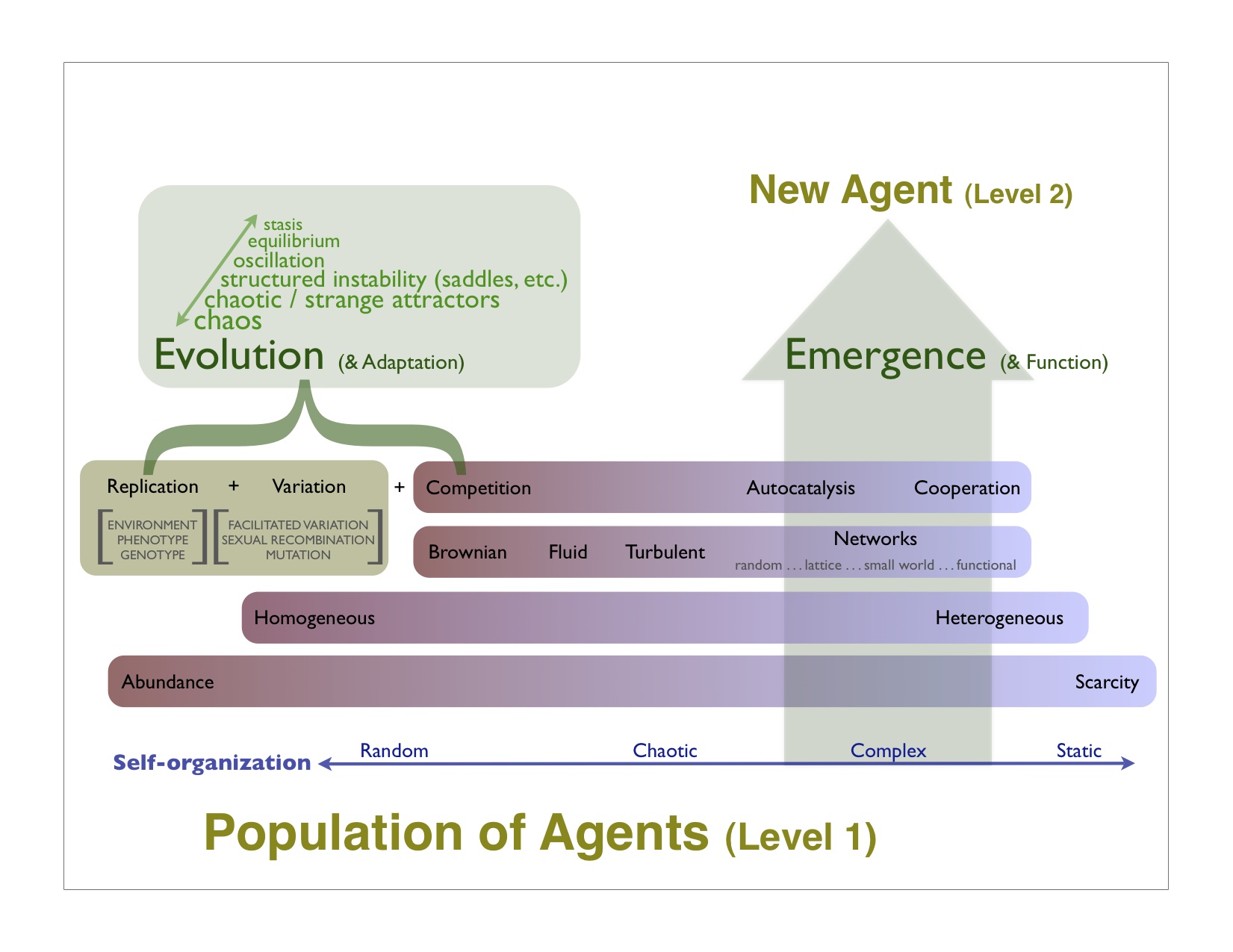
This chart shows concisely the most important factors that the generation inlfuyen emergent behaviors. Variation
element in the environment, influences the conditions for generating new alternatives adpated, welcoming new organic alternatives. Element
Shortage drives the generation of organic alternatives for more efficient use of resources or the exploitation of niche development.
Network Element allows the pursuit of different strategies in tackling problems in an organized
Cooperation element contributes to strategies that do not necessarily exploit local maxima but who dare to explore beyond the search for global maxima of efficiency use of resources.
This chart shows concisely the most important factors that the generation inlfuyen emergent behaviors. Variation
element in the environment, influences the conditions for generating new alternatives adpated, welcoming new organic alternatives. Element
Shortage drives the generation of organic alternatives for more efficient use of resources or the exploitation of niche development.
Network Element allows the pursuit of different strategies in tackling problems in an organized
Cooperation element contributes to strategies that do not necessarily exploit local maxima but who dare to explore beyond the search for global maxima of efficiency use of resources.
Thursday, January 7, 2010
Ww Points For Mini Bag Of Kettle Corn
Complex structures - Swarms
This amazing video shows the result of hundreds of thousands of birds flying and the impressive structures that form in the distance.
Numero Do Sereal Do Nero 3.1.0.25
Complexity - Who's Who
Navigating the Internet and to understand what is the scope of current research in the field of Complex Systems, come to an interesting list of the biggest names in the field of cybernetics and systemic thinkers:
press here To access
Xerex The Movie Free Watch
GIFT OF KINGS
On the day of Reyes, to open the mailbox of the house and dozens of brochures, I found a letter postmarked in Australia. Contained in the return address "Europcar Australasia", located in Tullamarine Airport (Melbourne). Glupssss ... Immediately, and before opening the envelope, I began to shuffle possibilities ... A fine for speeding? A fine stick too far left? A fine paste adhesives CSIC-RTVA in rented jeep doors? Glupssss ....
I prayed to the Three Kings and I opened the envelope ... Inside I found two palelitos. One of them was a credit card receipt worth $ 79.69 Australians. And the other was by the proof of that unexpected ... Why had we nailed those 80 bucks after returning the car? For if you do not see clearly in the attached image you copied the cause of the charge as we explain the curious Europcar manuscript:
"CHARGE. STEAM CLEAN. SAND - DIRT - ROCKS - EVERYWHERE"
(What I like is that "Everywhere" ... you also had stones in the tank?).
True to our legend, and worked on five continents, the Australians also consider us a enguarracoches . These Australians are a little sensitive ... as they get by some pebbles, some sand and some dirt ... So that there's rented SUV, to go to the Opera?
I prayed to the Three Kings and I opened the envelope ... Inside I found two palelitos. One of them was a credit card receipt worth $ 79.69 Australians. And the other was by the proof of that unexpected ... Why had we nailed those 80 bucks after returning the car? For if you do not see clearly in the attached image you copied the cause of the charge as we explain the curious Europcar manuscript:
"CHARGE. STEAM CLEAN. SAND - DIRT - ROCKS - EVERYWHERE"
(What I like is that "Everywhere" ... you also had stones in the tank?).
True to our legend, and worked on five continents, the Australians also consider us a enguarracoches . These Australians are a little sensitive ... as they get by some pebbles, some sand and some dirt ... So that there's rented SUV, to go to the Opera?
Manuel de la Riva as I remember once going to clear the terrain the operator assured them that they were cleaning cars but do not clear out ...
Wednesday, January 6, 2010
Is It Bad For Men To Suck On Ur Nipples
One of the current problems in the study of complex systems in general and Complex Adaptive Systems in particular, is how we measure them, and since the measurement of these systems is a basic requirement to a time to compare systems in a scientific and seek their optimization.
This is an open question, but there are alternatives that have been proposed, the latter of which I read in the book " Cosmic Evolution: The Rise of Complexity in Nature. Eric J. Chaisson."
presenting the complex history of the author tries to prove 2 things. On the one hand claims to show that increases in complexity are compatible with the second law of thermodynamics . The second law, in its statistical mechanical interpretation requires that the disorder increases in a closed system implying that the complexity (as opposed to deodorant) should decrease. However, a complex structure like a galaxy, a star or an organism is an open system, capable of sustaining sufficient complexity to exporting disorder to their environment, to more than justify their internal complexity increases. In fact, the second law is maintained because the disorder if increases in the larger system, one consisting of the complex structure but the surrounding environment. For example, increasing complexity in a young star, has a balance disorder that exports to its environment through radiation.
Your second goal is to demonstrate that the physical phenomenon that occurs complexity is the same for all these transitions . Very basic form that explains the phenomenon is as follows: Where there are strong gradients of energy, sometimes the conditions are correct for the spontaneous emergence of structures that tend to dissipate these gradients. While this gradient exists, these structures posrán be stable, maintained in a quasi-stable state of high complexity, this is far from equilibrium statistical-mechanical sense, by the flow of energy through them.
A classic example is the hurricane . This is a structure that arises from a thermal gradient enters the upper and lower atmosphere. This structure is complex, dissipative, ie allowing the reduction of this gradient by transferring warm air from the sea surface to the cold upper atmosphere.
The author argues that the stars are also dissipative structures dsipando energy gradients produced by the collapsing hydrogen clouds by gravitational force, or that biological organisms also confirm dissipative structures of the species contained high energy gradient between complex chemical structures of their food source, and low complexity of their excrement.
But how we measure complexity? This author proposes that a measure of its complexity can be the energy density. or the rate of flow of energy through dek system per unit mass, or φm. This amount, he argues, would be inversely proportional to the disorder of the system, and therefore in direct correlation with its complexity.
This assertion is not free of problems, however φm has the great virtue of being measurable in real systems. In this book the author shows the measurement calculations for a wide range of systems, including the sun (φm ~ 2 ergs / sec / gram), the human mind (150.000 ergs / sec / gram) and human civilization (500.000 ergs / sec / gram). Also a very interesting series of diagrams, he shows that galaxy φm society increases, and therefore also increases over time.
Because then this trend would exist φm? Basically, the author explains that in systems far from equilibrium (including the universe) the dominant dissipative structures are those that are able to capture the largest proportion of energy flow. Φm therefore should increase as new structures emerge (for fluctuations or mutations) and as the system "discovers" new routes dissipative.
This is an interesting alternative in learning about complex systems, its modeling and quantification.
Where Can You Watch Sean Cody Free?
Measuring Complexity Science Center Univ Complexity Warwick
Warwick University is becoming one of the most important European and world research of complex adaptive systems. You need to know how they work, as it can influence their effects, as is possible to measure the complexity.
This video shows the activity of this center and gives a little introduction pracicas potential applications of this way of dealing with complex phenomena.
is Quickly Becoming Warwick University on the main research centers at at european level in the subject of Complexuty Science and Complex Adaptive Systems. It's NECESSARY to determine how They work, how is it possible to Influence Their effects and how the Complexity Can Be Measured, for Effective scientific approach to STI management.
This video shows the activity of ths Research Center, and Introduced Briefly Some Practical Ways in Which this new form of complex Approaching Problems Can Be Applied.
Warwick University is becoming one of the most important European and world research of complex adaptive systems. You need to know how they work, as it can influence their effects, as is possible to measure the complexity.
This video shows the activity of this center and gives a little introduction pracicas potential applications of this way of dealing with complex phenomena.
is Quickly Becoming Warwick University on the main research centers at at european level in the subject of Complexuty Science and Complex Adaptive Systems. It's NECESSARY to determine how They work, how is it possible to Influence Their effects and how the Complexity Can Be Measured, for Effective scientific approach to STI management.
This video shows the activity of ths Research Center, and Introduced Briefly Some Practical Ways in Which this new form of complex Approaching Problems Can Be Applied.
Monday, January 4, 2010
Boat Registering In Ontario Canada
Solving the traffic like ants
The use of algorithms based on the organization of the ants for the generation of models for traffic control, seems to be a prometerdora application of distributed intelligence of swarms, and agent-based modeling. Report is in English.
The use of algorithms based on ant organization for the generation of Traffic control models, Appears to Be a promessing application for Distributed Intelligence, and agent based models. Video in Inglés
The use of algorithms based on the organization of the ants for the generation of models for traffic control, seems to be a prometerdora application of distributed intelligence of swarms, and agent-based modeling. Report is in English.
The use of algorithms based on ant organization for the generation of Traffic control models, Appears to Be a promessing application for Distributed Intelligence, and agent based models. Video in Inglés
Subscribe to:
Posts (Atom)